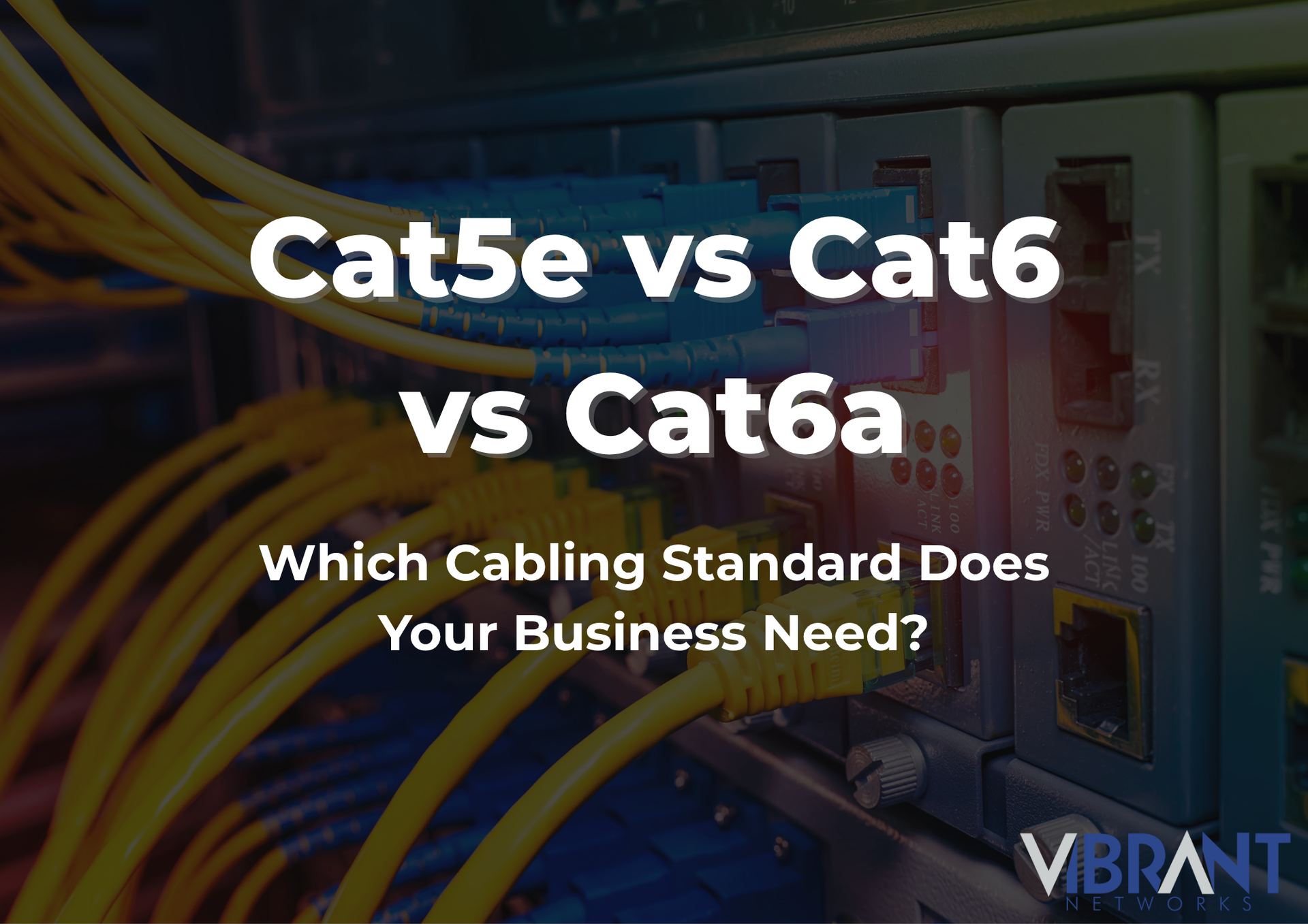
Cat5e vs Cat6 vs Cat6a: Which Cabling Standard Does Your Business Need?
Shaan Randhawa
The quick answer: For most SMEs fitting out or moving into a new office, Cat6 is the right choice. It supports speeds up to 10Gbps over short distances, handles modern business applications comfortably, and is future proof enough for most growing organisations. Cat5e is outdated for new installations. Cat6a is worth considering for larger offices, data intensive environments, or businesses planning significant growth. The cabling standard you choose today will determine your network's performance for the next 10–15 years.
| Cat5e | Cat6 | Cat6a | |
|---|---|---|---|
| Maximum speed | 1Gbps | 10Gbps (up to 55m) | 10Gbps (up to 100m) |
| Suitable for modern business | Marginally | Yes | Yes — high demand environments |
| Futureproof | No | For most SMEs | Yes |
| Cost | Lowest | Mid range | Highest |
| Best for | Legacy only — not recommended for new installs | Most SME office fit-outs | Larger offices, data centres, high-growth businesses |
(Skip to whichever section is most relevant to your situation).
What is structured cabling and why does the standard matter?
Structured cabling is the physical backbone of your office network. The standard you choose determines your network's performance, reliability, and upgrade capacity for the next decade.
Unlike Wi-Fi, which can be reconfigured or upgraded relatively easily, physical cabling is built into the fabric of your office. Replacing it is disruptive and expensive. Getting the standard right during a fit out or office move is significantly more cost effective than upgrading it later.
For businesses across the West Midlands planning a new office, expansion, or refurbishment, cabling decisions made today will directly affect network performance well into the future
What is Cat5e cabling and should your business use it?
Cat5e is an older cabling standard that supports speeds up to 1Gbps, which is adequate for basic internet browsing but increasingly unsuitable for modern business applications.
Cat5e was the standard for most office installations through the 2000s and early 2010s. Many businesses still run on it. In environments with light network usage it functions adequately, but it struggles to support the bandwidth demands of cloud platforms, VoIP systems, video conferencing, and multiple simultaneous users at scale.
For new installations in 2025 and beyond, Cat5e is not recommended. The cost saving over Cat6 is minimal at installation, and the performance limitation becomes increasingly apparent as business demands grow.
What is Cat6 cabling and is it right for your business?
Cat6 supports speeds up to 10Gbps over distances of up to 55 metres and is the recommended standard for most SME office fitouts and new installations.
Cat6 handles the full range of modern business applications, (cloud platforms, VoIP, Microsoft Teams, video conferencing, and high density wireless access points), without the bottlenecks that Cat5e creates under load. It is backward compatible with existing Cat5e equipment, making it a straightforward upgrade path.
For most growing businesses across the West Midlands, Cat6 represents the right balance of performance, cost, and futureproofing. It is the standard Vibrant Networks recommends for the majority of SME office fitouts and relocations.
What is Cat6a cabling and when does your business need it?
Cat6a supports 10Gbps speeds over the full 100 metre standard distance and is designed for high demand environments where Cat6's distance limitations would create performance issues.
The "a" in Cat6a stands for augmented. It uses thicker, more heavily shielded cable that eliminates crosstalk interference at higher speeds over longer runs. This makes it the preferred standard for:
- Larger offices where cable runs regularly exceed 55 metres
- Data centres and server rooms requiring sustained high speed connectivity
- Businesses with significant data transfer requirements, such as large file handling, video production, or high volume cloud operations
- Organisations planning substantial growth who want to futureproof their infrastructure for 15+ years
The trade off is cost and installation complexity. Cat6a cable is bulkier and more difficult to route than Cat6, and the hardware to support it is more expensive. For most SMEs, this investment is not necessary. However, for the right environment, it is worth every penny.
How do you choose the right cabling standard for your office?
The right cabling standard depends on three factors: the size of your office, the intensity of your network usage, and how long you plan to stay in the space.
A practical decision framework:
- Small office, light usage, short lease: Cat6 is more than sufficient and cost effective
- Medium office, cloud heavy operations, growing team: Cat6 is the standard recommendation, with Cat6a considered for specific high-demand areas such as server rooms
- Large office, data intensive operations, or long term premises: Cat6a is worth the investment for full run performance and maximum futureproofing
- Existing Cat5e infrastructure: assess whether performance issues justify a full recable, or whether targeted upgrades to high demand areas are sufficient
A site survey will identify the specific requirements of your premises before any cabling decision is made. This is an essential step that avoids both over specification and underperformance.
How Vibrant Networks can help
At Vibrant Networks, we design and install structured cabling for businesses across the West Midlands, from single office fit outs to multisite infrastructure projects. Every installation begins with a site survey to ensure the right cabling standard is specified for the environment, the usage, and the business's growth plans.
We offer a free, no obligation IT and connectivity review for businesses across the West Midlands and beyond, including cabling assessment for new offices, expansions, and existing infrastructure that may need upgrading.
Call 01922 612387 to arrange your free review, or explore our Network Design case studies to see how we have helped West Midlands businesses build infrastructure that supports their next stage of growth.
Frequently Asked Questions
What is the difference between Cat5e and Cat6 cabling? Cat5e supports speeds up to 1Gbps and was the standard for most office installations until the mid 2010s. Cat6 supports speeds up to 10Gbps over distances of up to 55 metres and handles the bandwidth demands of modern business applications, such as cloud platforms, VoIP, and video conferencing, significantly more effectively. For any new installation, Cat6 is the recommended minimum standard.
Is Cat6 or Cat6a better for a small business? For most small businesses, Cat6 is the better choice. It provides more than sufficient performance for modern applications at a lower cost and with easier installation than Cat6a. Cat6a is primarily beneficial in larger offices where cable runs exceed 55 metres, or in high demand data environments. A site survey will confirm which standard is appropriate for your specific premises.
How long does structured cabling last? Properly installed structured cabling typically has a functional lifespan of 15–20 years. The cabling standard, however, may become a performance limitation before the physical cable fails, which is why choosing the right standard at installation is important. Cat5e installations from the early 2000s are increasingly being replaced not because the cable has failed, but because it can no longer support modern network demands.
Can I mix Cat5e and Cat6 cabling in the same office? Yes. Cat6 is backward compatible with Cat5e equipment. However, the network will perform at the speed of the slowest component. If Cat5e runs exist alongside Cat6, those runs will limit performance to 1Gbps regardless of what Cat6 infrastructure surrounds them. In most cases, a full recable to a consistent standard delivers better results than a mixed installation.
What does a structured cabling installation involve?
A structured cabling installation begins with a site survey to assess the office layout, identify cable routes, and specify the correct hardware. Cable is then installed through walls, ceilings, and floor voids to wall ports at each workstation, with patch panels installed in a central cabinet or server room. The installation is then tested and certified to confirm it meets the specified standard. A properly documented, certified installation also adds value when the time comes to expand or sell the business.